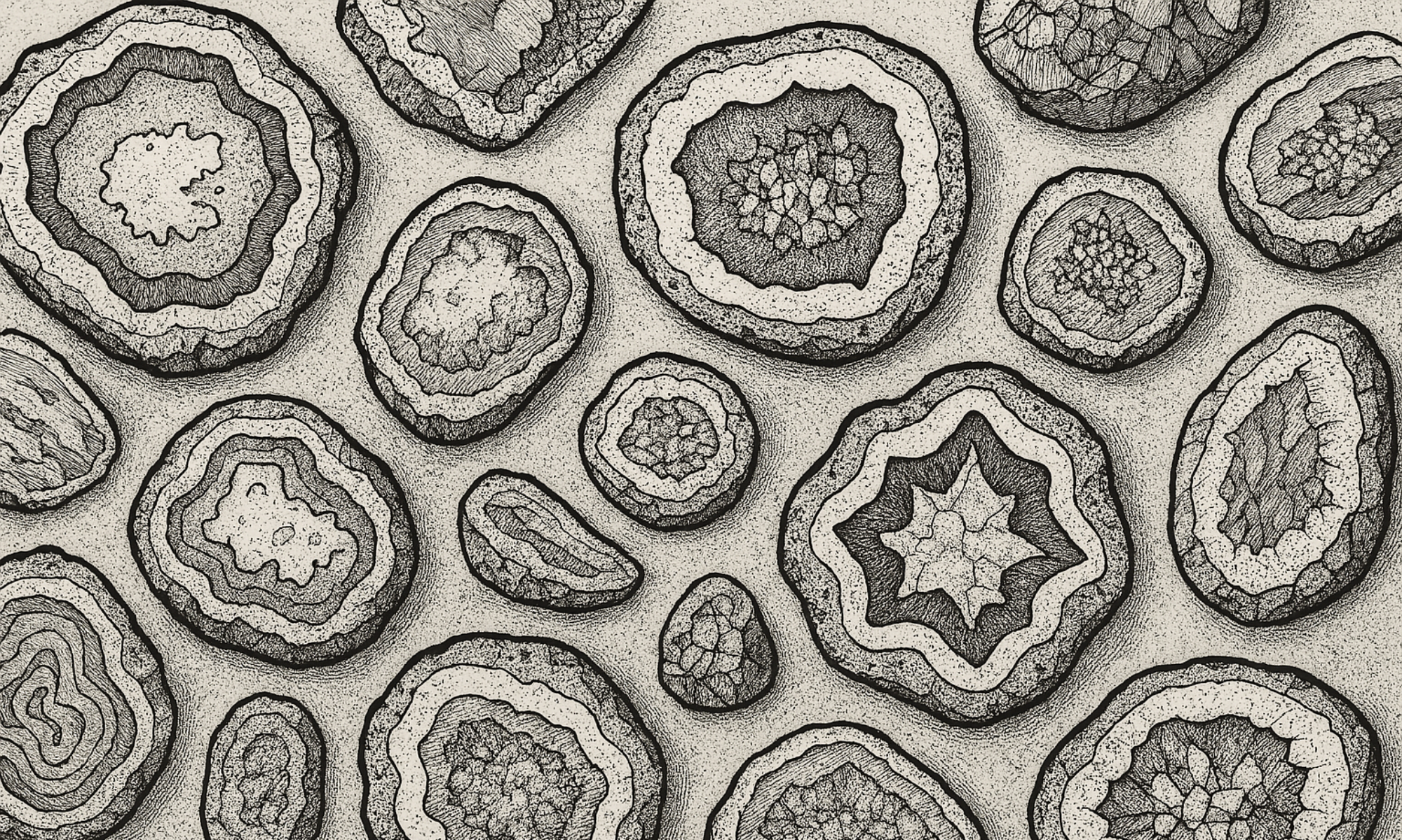
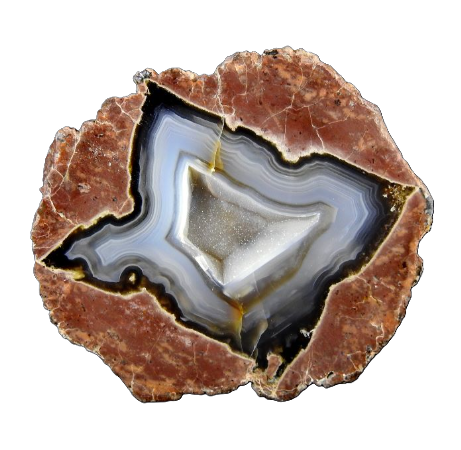
Thundereggs are one of those rocks that make perfect sense once you understand the geology, but at first glance they seem strange. From the outside, they often look like ordinary lumpy nodules. Cut one open, though, and you might find agate, quartz crystals, jasper, opal, or intricate patterns hidden inside. That contrast is what makes them so appealing to collectors.
So how does something like that form?
It Starts with Volcanic Activity
Most thundereggs begin in silica-rich volcanic rock, usually rhyolite. Millions of years ago, lava flows and volcanic ash deposits cooled and hardened across parts of the Pacific Northwest and other volcanic regions.
As that volcanic material cooled, it didn’t do so perfectly. Changes in temperature, trapped gases, and shrinking rock created weak zones, cavities, and irregular pockets within the rhyolite. These weren’t necessarily large open holes like you’d see in bubbly basalt — often they were smaller, more complex internal spaces or zones where minerals could later concentrate.
Those imperfections set the stage for thunderegg formation.
Silica-Rich Fluids Move In
After the volcanic rock had cooled enough to crack and become chemically active, groundwater carrying dissolved silica began moving through it. This silica often came from the surrounding volcanic ash and rock slowly breaking down over long periods of time.
As mineral-rich fluids seeped into those cavities and weak zones, silica started depositing layer by layer. Depending on chemistry, temperature, pressure, and trace minerals present, that silica could form:
- Chalcedony
- Agate
- Jasper
- Common opal
- Quartz crystals
That’s why no two thundereggs look exactly alike. The exact conditions changed from one pocket to another.
Why the Outside Looks So Plain
The outer shell of a thunderegg is usually the original host rhyolite or altered volcanic material, which tends to be rough and fairly dull-looking. The more interesting mineral growth happened inside, where silica-rich fluids had room to deposit and crystallize.
That’s why thunderegg collecting always involves a little mystery — the outside rarely tells the whole story.
Why Some Are Solid and Some Have Cavities
Not every thunderegg forms the same way.
In some cases, silica completely fills the available space, leaving a solid nodule of agate or chalcedony. In others, deposition stops before the cavity fills entirely, leaving an open center where quartz crystals can grow later.
That’s why one thunderegg might be solid banded agate while another from the same area contains a crystal pocket.
Where the Patterns Come From
Those swirls, bands, plumes, mossy inclusions, and strange shapes come from changes in the chemistry of the mineral-rich fluids over time. Tiny amounts of iron, manganese, or other trace elements can dramatically change color and pattern.
Silica doesn’t always deposit evenly, either. Slight differences in flow paths, mineral concentration, and crystal growth conditions create the patterns collectors love.
Why Certain Areas Produce Better Eggs
Not all volcanic terrain makes thundereggs. You need a fairly specific combination of:
- Silica-rich volcanic host rock (often rhyolite)
- Internal cavities or structural weak zones
- Long-term groundwater movement
- The right chemistry for silica deposition
- Enough geologic time
That’s why certain places became famous — like Oregon’s thunderegg beds, Washington’s scattered deposits, or Idaho localities like Rabbit Springs. The conditions lined up there.
Why They’re Called Thundereggs
The name comes from Native American legends, particularly in Oregon, where stories described thunder spirits hurling stones during storms. The nodules found in volcanic terrain became associated with those stories, eventually earning the name “thunderegg.”
Geologically, they’re simply volcanic nodules filled with secondary silica minerals — but “thunderegg” is a much better name.
Closing Thoughts
Thundereggs are essentially geological time capsules formed by volcanic activity, groundwater, chemistry, and patience on a scale far beyond human experience.
What starts as a rough lump of volcanic rock can, given enough time, become a hidden pocket of agate, quartz, or opal waiting to be discovered. That unpredictability is part of what keeps rockhounds cutting open just one more egg.